Why use an AGV instead of a manual forklift? The answer begins with movement, not machinery. In a busy warehouse, a manual forklift may carry pallets quickly, yet it depends on trained operators, clear visibility, and constant attention. An automated guided vehicle can follow mapped routes, stop near marked zones, and repeat transport tasks with steady timing. That consistency matters beside loading docks, storage aisles, and production lines.
Tye Brady, former Chief Technologist at Amazon Robotics, once said, “Robots don’t take jobs; they change jobs.” His point helps frame this decision responsibly. An AGV does not simply replace a forklift. It can move repetitive loads while employees focus on inspection, replenishment, and exception handling. The benefit becomes visible when the same pallet travels 200 meters every fifteen minutes, throughout an entire shift.
Still, the choice is not automatic. A manual forklift may remain better for irregular loads, changing routes, or low-volume operations. An AGV needs suitable floor conditions, reliable traffic rules, charging space, and accurate process data. Small layout changes can expose weak planning. That is the uncomfortable part.
The strongest evaluation combines warehouse observations, safety reviews, and measurable trials. Managers should compare travel time, labor effort, downtime, collision risks, and total operating cost. One pilot may reveal more than a confident sales presentation. The goal is not to pursue automation for its own sake. It is to decide whether an AGV creates safer, more predictable material flow than a manual forklift in this specific facility.
What Is an AGV and How Does It Operate?
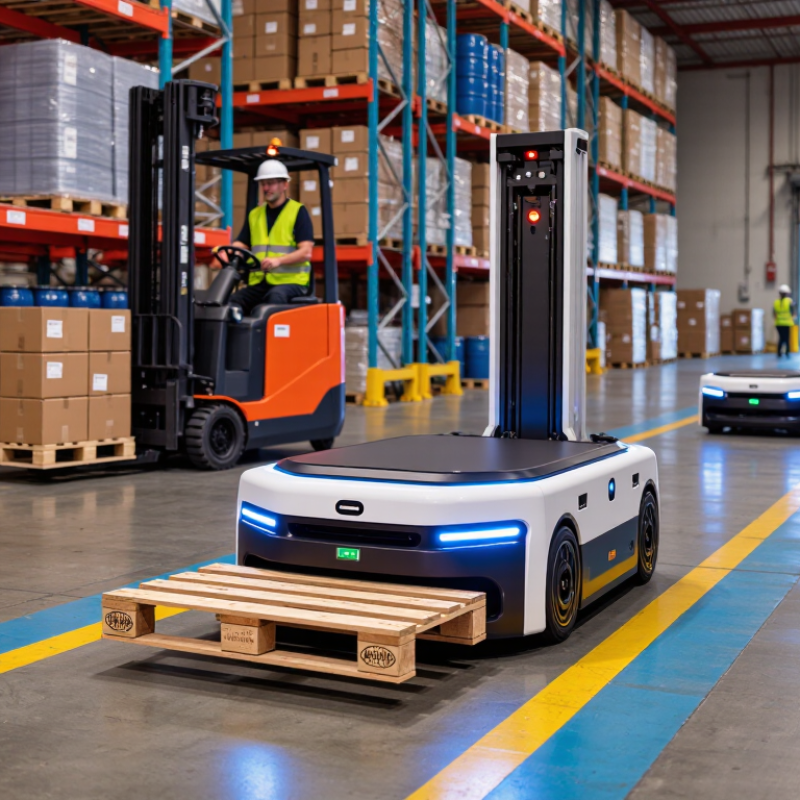
An automated guided vehicle, or AGV, is a mobile machine designed to transport materials without a driver. It moves between defined locations, such as storage lanes, production areas, and loading points. Unlike a manual forklift, it follows programmed routes and responds to operating instructions. Guidance may come from floor markers, magnetic paths, laser navigation, cameras, or digital maps. The selected system depends on the building, traffic, and floor condition.
During operation, onboard sensors monitor obstacles, people, rack positions, and route changes. If a worker enters its path, the AGV slows down or stops. At a marked station, it can collect or release a pallet using forks, conveyors, or lifting platforms. Its control system may connect with warehouse software, allowing tasks to be assigned and tracked. Operators still configure routes, inspect equipment, and manage unusual situations. Small errors matter.
Choosing an AGV instead of a manual forklift can improve repeatability in high-volume transport. It may also reduce unnecessary driving and support more consistent movement during long shifts. However, an AGV is not a universal replacement. A blocked aisle, poor lighting, damaged floor marker, or incorrectly positioned pallet can interrupt the workflow. Real facilities need clear traffic rules, routine maintenance, and trained supervision. The first route is seldom perfect. That assumption can fail.
How AGVs Compare with Manual Forklifts
Comparing AGVs with manual forklifts starts with the work, not the machine.
A manual forklift suits changing aisles, mixed loads, and urgent, one-off moves. It also needs a trained operator on every shift. An AGV follows mapped routes and repeats pallet transfers with consistent timing. The International Federation of Robotics reported nearly 113,000 transport and logistics robots sold worldwide in 2023. That figure shows industrial momentum, not automatic savings. AGV projects still need reliable pallets, charging space, and disciplined traffic rules.
Safety changes in a different way.
OSHA cites about 85 annual U.S. deaths and 35,000 serious injuries involving powered industrial trucks. Removing drivers from repetitive routes can reduce exposure, but it does not remove hazards. Sensors may miss damaged pallets, reflective surfaces, or people entering blind corners. Manual forklifts react better when an experienced driver sees an unusual obstruction. AGVs perform better when the same task repeats for hours. The comparison is not clean.
Cost depends on utilization.
A forklift may be cheaper for seasonal demand or scattered storage. An AGV can become attractive when routes remain stable and labor coverage is difficult. MHI’s 2024 Annual Industry Report identifies robotics and automation as major planned investment areas among supply-chain organizations. However, planned investment is not proof of payback. Measure travel distance, idle time, loading delays, incidents, and maintenance hours before choosing. I would also test failure recovery. A system that stops safely but waits twenty minutes can still disrupt production.
Key Safety Advantages of AGV Deployment
Why Use an AGV Instead of a Manual Forklift?
Key Safety Advantages of AGV Deployment
Manual forklifts place operators close to moving loads, blind corners, and reversing traffic. The risk is measurable. OSHA reports nearly 100 forklift-related worker deaths and about 35,000 serious injuries annually in the United States. AGVs can reduce direct exposure by transporting pallets without an onboard driver. They follow programmed routes, observe defined speed limits, and stop when sensors detect people or obstacles. That consistency matters during night shifts, when fatigue can affect human reactions.
Safety still depends on engineering and daily discipline. ISO 3691-4:2020 requires risk-based safeguards for driverless industrial trucks, including protective fields, emergency stops, and controlled operating zones. In practice, a well-designed AGV system can separate pedestrian lanes from vehicle paths. It can also record stops, near misses, and route interruptions. These records help safety teams identify repeated hazards instead of relying only on memory.
AGVs are not magic. Poor mapping, weak maintenance, or rushed deployment can create new risks. A sensor may stop a vehicle, but it cannot repair a damaged pallet. Workers still need clear training and permission to challenge unsafe routes. This is where some projects fall short. They automate movement before reviewing the warehouse layout. A safer approach combines documented risk assessments, physical barriers, visible warning signals, and regular human audits. The technology reduces routine exposure, but responsible supervision remains essential.
Why Use an AGV Instead of a Manual Forklift?
Key safety advantages of AGV deployment are best understood against the documented safety burden of powered industrial trucks.
In the United States, forklifts are associated with approximately 85 fatalities, 34,900 serious injuries, and 61,800 non-serious injuries each year. AGVs can reduce operator exposure by removing the driver from the vehicle, following controlled routes, using obstacle detection, and applying automatic stopping or speed control. AGVs still require appropriate risk assessment, safeguards, supervision, and maintenance.
Source: U.S. Occupational Safety and Health Administration, Powered Industrial Trucks safety information.
How AGVs Improve Productivity and Workflow Control
Manual forklifts depend on operator availability, traffic awareness, and consistent driving habits. An AGV follows mapped routes, digital work orders, and defined safety zones. It can move pallets between receiving, storage, and production without waiting for a driver. This creates a steadier workflow, especially during night shifts or repetitive transfers. The 2024 MHI Annual Industry Report found that 55% of supply chain leaders planned to increase technology investment. That figure reflects growing pressure to control labor gaps and improve material flow.
AGVs also produce useful operating data. Each trip can record location, waiting time, battery status, and delivery completion. Supervisors can then identify a blocked aisle or a slow handoff before it delays an entire line. Deloitte’s 2024 Smart Manufacturing and Operations Survey reported that 86% of manufacturers view smart manufacturing as important for competitiveness. The connection is practical, not magical. Better data only helps when teams act on it.
There is a weakness.
An AGV may struggle with changing layouts, poor floor markings, or unusual loads. A manual forklift can improvise faster in some conditions. Companies should test real routes, loading points, and exception handling before scaling deployment. Otherwise, a polished automation project may simply move delays from the driver’s seat into the software queue.
Costs, Limitations, and Suitable Applications of AGVs
Why Use an AGV Instead of a Manual Forklift?
An AGV can reduce repetitive driving, labor pressure, and collision exposure in structured warehouses. However, its higher purchase cost is only part of the investment. Site mapping, route design, charging stations, software integration, floor preparation, and employee training also affect the budget. Maintenance remains necessary. Sensors need cleaning, batteries need monitoring, and traffic rules require regular review.
A rushed calculation can make an AGV look cheaper than it is. Productivity may fall when pallets are damaged, aisles become blocked, or loads differ from planned specifications. AGVs also depend on reliable navigation conditions. Uneven floors, poor lighting, temporary obstacles, and frequent layout changes can interrupt operations. Human forklift drivers usually handle unusual situations faster. That flexibility still comes with training costs, fatigue risks, and inconsistent driving performance.
AGVs suit repetitive, predictable movements between fixed points. Common applications include pallet transport, production-line feeding, warehouse replenishment, and controlled cold-storage routes. They work especially well when travel distances are long and loads follow stable patterns. A mixed fleet may be more practical. AGVs can manage routine routes while trained operators handle exceptions and urgent tasks. The decision should come from measured traffic data, shift patterns, load types, and safety observations, not from automation enthusiasm alone. Some facilities may discover that a partial deployment fits better.
Conclusion
Why use an AGV instead of a manual forklift? An automated guided vehicle (AGV) follows programmed routes or navigates through a facility using sensors, software, and predefined safety controls. Unlike a manually operated forklift, an AGV can transport materials consistently with less dependence on operator availability, reducing repetitive handling and helping create a more predictable workflow. Its controlled movement, obstacle detection, and automatic stopping features can also lower the risk of collisions and workplace injuries when properly installed and managed.
AGVs can improve productivity by supporting continuous material flow, accurate delivery timing, and better coordination between storage, production, and shipping areas. However, they require an upfront investment, suitable facility layouts, system integration, regular maintenance, and trained personnel. They may be less flexible than manual forklifts when handling unusual loads or constantly changing routes. For businesses with repetitive transport tasks, stable processes, and a strong focus on safety and efficiency, AGVs can be a practical long-term solution; manual forklifts may remain more suitable for irregular, highly flexible operations.

 AJ Forklifts