Optimizing aisle width for narrow aisle forklifts is not simply a matter of making every passage as tight as possible. It is a controlled balance between storage density, truck dimensions, operator visibility, pallet condition, and emergency access. The target width must support confident turning, accurate pallet placement, and consistent travel without forcing operators to scrape racks or stop repeatedly.
Warehouse engineering consultant Michael R. Hayes explains, “The narrowest aisle is rarely the most productive aisle; the best aisle is the one operators can use safely and repeatedly.” This practical view reflects real warehouse conditions. A forklift may fit on paper, yet fail during peak shifts when pallets overhang, floors become dusty, or loads vary in size. Small errors grow quickly.
A reliable approach to How to optimize aisle width for narrow aisle forklifts begins with measured equipment data. Record the forklift’s right-angle stacking width, turning radius, load length, and required clearance. Then test the proposed aisle with the largest normal pallet, not an idealized load. Leave room for steering correction. Leave room for people.
Do not trust a single drawing.
Trial runs can reveal blind corners, rack damage risks, and uncomfortable operator movements. These details are often missed during planning. It is also worth reviewing pedestrian routes, floor flatness, lighting, and rack protection before final approval. The result may sacrifice a few pallet positions. That is not necessarily failure. A slightly wider aisle can improve cycle consistency, reduce product damage, and support safer long-term performance.
Why Optimize Aisle Width for Narrow Aisle Forklifts?
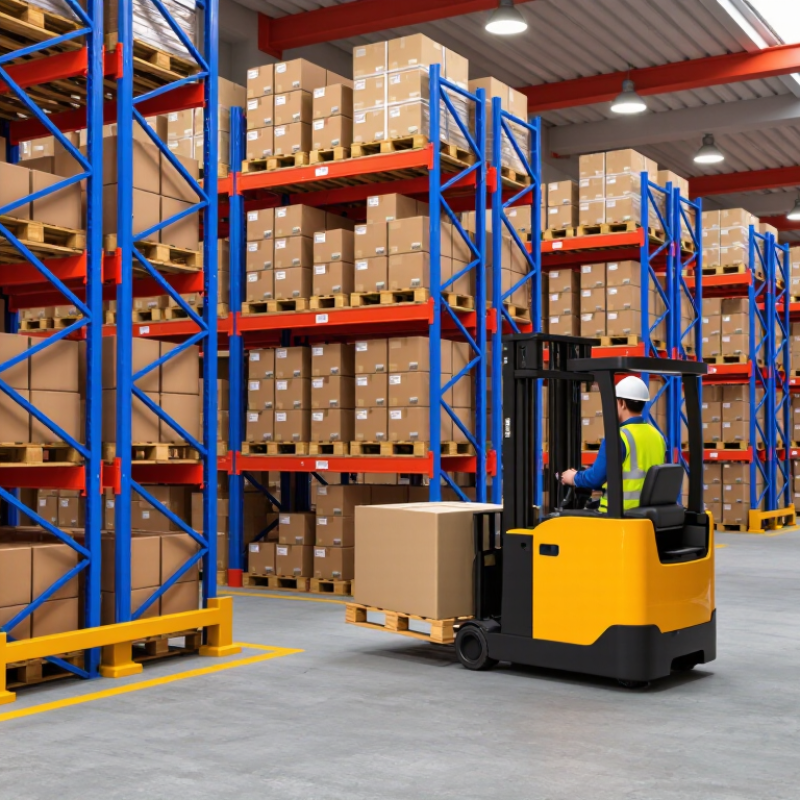
A narrow aisle forklift is designed for storage areas where every floor meter matters. Common types include reach trucks, turret trucks, and articulated forklifts. They often operate in aisles measuring about 8 to 10 feet wide. Conventional counterbalanced forklifts may require 12 feet or more. Their compact chassis, smaller turning radius, and elevated mast support denser rack layouts. Some models turn inside the aisle. Others travel straight while their forks rotate or extend sideways. The operating method changes with the truck design.
Aisle width must match the loaded truck, pallet overhang, rack protection, and operator visibility. A few extra inches can prevent contact with uprights and reduce product damage. OSHA safety materials have estimated 35,000 serious forklift injuries annually in the United States. Poor clearance can increase that exposure. A practical warehouse assessment should measure turning paths, floor unevenness, rack deflection, and emergency access. Industrial Truck Association guidance also shows that published minimum aisle dimensions vary by truck and load. Brochure measurements alone are not enough. The perfect aisle does not exist.
Tips: Measure the loaded truck. Mark the turning envelope. Test with real pallets. Check visibility at maximum lift. Recheck clearances after rack changes. A rushed test may reveal nothing.
A practical comparison of narrow-aisle forklift characteristics, operating requirements, and aisle-width considerations for warehouse planning.
| Planning Dimension | Key Measure | Typical Range or Condition | How It Affects Operation and Warehouse Design |
|---|---|---|---|
| Forklift Definition | Equipment type | Electric reach truck or turret truck designed for restricted aisles | Narrow-aisle forklifts use compact chassis, precise steering, and electric drive systems to place and retrieve pallets where standard counterbalance trucks may not have enough turning space. |
| Typical Aisle Width | Rack-to-rack working aisle | Approximately 2.4–3.0 m for reach trucks; about 1.5–2.0 m for very-narrow-aisle turret trucks | The required width depends on the truck model, pallet dimensions, load orientation, rack layout, turning method, and the clearance needed for safe load handling. |
| Standard Pallet Reference | Load footprint | Common pallet sizes include 1,200 × 800 mm and 1,200 × 1,000 mm | Aisle calculations should use the actual pallet size, load overhang, fork length, rack depth, and the direction in which pallets enter and leave storage locations. |
| Load Capacity | Rated capacity | Often approximately 1,000–2,500 kg, depending on truck type and lift height | Capacity decreases as lift height increases or the load center becomes longer. The truck data plate and the load chart must be checked before selecting storage and handling equipment. |
| Lift Height | Maximum fork height | Roughly 6–13 m for many narrow-aisle applications | Higher racks increase storage density but require suitable mast design, floor flatness, rack tolerances, lighting, and operator visibility or guidance systems. |
| Turning Requirement | Turning radius and maneuvering path | Smaller than conventional counterbalance trucks; exact values vary by chassis and load | A smaller turning envelope allows more storage locations, but the aisle must still accommodate the truck, pallet, rack protection, and safe load placement without contact. |
| Steering and Travel | Steering configuration | Responsive electric steering; some turret trucks rotate forks or the mast within the aisle | Precise steering reduces unnecessary lateral clearance. Turret-style systems can handle pallets at both sides of a very narrow aisle while the truck remains aligned with the aisle. |
| Power System | Energy source | Battery-powered electric drive, commonly using lead-acid or lithium-ion batteries | Electric operation produces no direct exhaust emissions at the point of use and is suitable for enclosed warehouses. Battery capacity, charging time, and duty cycle must match the work schedule. |
| Floor Requirements | Surface quality and flatness | Smooth, level, load-bearing concrete with tolerances suitable for the truck and lift height | Uneven floors can increase mast sway, reduce load stability, and restrict travel speed. High-lift operations usually require tighter floor control than low-level pallet movement. |
| Rack Compatibility | Storage system | Selective pallet racking, double-deep racking, or very-narrow-aisle racking | Rack beam levels, upright protection, pallet clearances, and load backstops must be coordinated with the forklift's fork reach, mast dimensions, and maximum load size. |
| Operator Visibility | View of forks and load | Improved visibility through elevated operator position, camera systems, mirrors, or guided travel features | Good visibility supports accurate pallet placement and reduces rack impacts. At greater heights, cameras, positioning indicators, and warehouse lighting can improve control. |
| Guidance Systems | Aisle guidance | Optional wire guidance, rail guidance, laser guidance, or visual positioning aids | Guidance can reduce steering corrections and help maintain consistent clearance in very narrow aisles. It adds installation and maintenance requirements that should be included in the project plan. |
| Travel Speed | Operating speed | Varies by model, load, aisle condition, lift height, and safety settings | Narrow aisles do not automatically increase throughput. Travel speed may be limited near racks, intersections, pedestrians, doorways, and elevated loads to maintain safe control. |
| Storage Density | Use of floor area | Higher pallet density than layouts designed for conventional counterbalance trucks | Reducing aisle width can create additional rack positions or free floor space. The gain should be balanced against access frequency, replenishment routes, fire codes, and emergency egress requirements. |
| Throughput Impact | Pallet movements per hour | Depends on travel distance, lift height, aisle congestion, operator skill, and battery availability | The optimum aisle is not always the narrowest aisle. A slightly wider layout may improve turning, reduce corrections, and increase total throughput when order activity is high. |
| Safety Clearance | Working and pedestrian separation | Must be determined from a site-specific risk assessment and applicable local regulations | Aisle design should account for rack deflection, load variation, pedestrian exclusion, intersections, emergency access, falling-object risks, and the possibility of pallet misalignment. |
| Best-Fit Applications | Warehouse use case | High-density pallet storage, distribution centers, cold rooms, and facilities with expensive floor area | Narrow-aisle equipment is most beneficial when pallet storage density and vertical space are more important than unrestricted truck movement across the facility. |
| Primary Trade-Off | Density versus flexibility | More storage positions but less room for mixed equipment and casual maneuvering | A narrow layout can lower real-estate use per pallet, while a wider layout may simplify operations, accommodate multiple truck types, and provide greater flexibility for changing pallet sizes. |
| Optimization Method | Aisle-width selection process | Use the manufacturer's rated working aisle, then validate it through site measurements and operational testing | Measure the actual truck, load, rack, and floor conditions. Test turning and pallet placement with representative loads before finalizing rack positions or reducing an existing aisle. |
Planning note: The figures shown are general industry ranges rather than design specifications. Final aisle dimensions must be confirmed using the selected forklift's technical data, the actual pallet and load dimensions, rack geometry, floor conditions, and applicable workplace-safety requirements.
Measure pallet length, load overhang, rack depth, turning radius, and load center. Include the widest realistic load.
Wrapping and uneven cartons may increase its width to 1,060 millimeters. Small differences can affect turning clearance.
Use the technical figures as a starting point. Confirm them with a loaded pallet and a physical driving trial.
Allow space for steering corrections, pallet drift, rack movement, floor defects, and rear swing. Perfect drawings can mislead.
Drive forward, turn, align, and reverse with a loaded pallet. Watch pallet corners, rear swing, visibility, and raised-load clearance.
They may create space for extra rack positions. A 300-millimeter reduction across a 24-meter aisle can be significant.
Keep pedestrians, emergency routes, and maintenance access outside equipment paths. Follow local safety requirements and site risk assessments.
Place fast-moving pallets near dispatch areas. Store heavy loads lower and slower inventory higher, without blocking lighting or sprinklers.
Track turning time, travel distance, near misses, product damage, and charging delays. Operator feedback may reveal hidden problems.
Review it after several weeks and after pallet, attachment, or rack changes. The first layout is rarely perfect.
Narrow aisle forklifts are designed to operate efficiently in restricted warehouse spaces, allowing businesses to store more products without sacrificing access. Their compact structure, precise steering, and lifting capabilities make them suitable for high-density storage systems. However, aisle width directly affects maneuverability, turning clearance, pallet access, travel speed, and overall warehouse capacity. Choosing aisles that are too narrow may increase handling difficulty and safety risks, while overly wide aisles can reduce valuable storage space.
How to optimize aisle width for narrow aisle forklifts begins with measuring the forklift’s turning radius, load dimensions, pallet size, lift height, and required operating clearance. Warehouse managers should also consider floor conditions, visibility, traffic patterns, operator training, and emergency access. By balancing equipment requirements with storage goals, businesses can improve space utilization, reduce unnecessary travel, support safer operations, and maintain efficient product movement. Regular reviews are also important as inventory, equipment, and warehouse layouts change over time.

 AJ Forklifts