Cold storage is not simply a warehouse with lower temperatures. It changes battery behavior, hydraulic response, traction, visibility, and operator comfort. The question is direct: How do cold storage environments affect forklift performance? The answer depends on temperature, humidity, duty cycle, floor conditions, and truck design.
The Global Cold Chain Alliance’s 2020 Global Cold Storage Capacity Report recorded about 719 million cubic meters of refrigerated storage worldwide in 2018. That scale highlights the growing need for reliable material-handling equipment. Inside a freezer at -25°C, lead-acid batteries may lose usable capacity, while oil becomes thicker and mast movements feel slower. Condensation can also freeze around doors, sensors, and electrical connections. Small issues become expensive delays.
Cold rooms expose weak maintenance habits.
OSHA 29 CFR 1910.178 requires powered industrial trucks to receive inspections at least daily, or after each shift in continuous operation. ANSI/ITSDF B56.1 also provides widely used safety guidance for powered industrial trucks. These standards support a practical review of the 2026 top forklifts, but they cannot replace site-specific testing. A model that performs well in a showroom may struggle after repeated transitions between a warm dock and a freezer aisle. That point is easy to underestimate. This introduction therefore examines battery chemistry, cold-rated hydraulics, tire grip, defrosting routines, operator protection, and total operating cost. It also questions whether a higher purchase price always delivers better cold-storage performance. Sometimes, it does not.
In 2026, forklift performance depends heavily on the storage temperature. At –18°C, batteries lose usable capacity, hydraulic oil thickens, and rubber tires become less flexible. Operators may notice slower lifting and weaker acceleration during long shifts. Condensation appears when equipment leaves the freezer, creating risks for electrical connectors and braking components. A short warm-up period outside the cold room can reduce these problems.
At –30°C, deep-freeze work becomes much more demanding. Standard forklifts may suffer rapid battery drain, stiff seals, brittle plastics, and delayed hydraulic response. Lubricants must suit extreme cold, while battery charging areas need controlled temperatures. Maintenance teams should inspect forks, chains, mast rollers, and warning lights more frequently. Small cracks can become serious after repeated freezing cycles. Field checks often reveal an uncomfortable truth: operating schedules are sometimes more optimistic than the equipment allows.
Tips: Use cold-rated lubricants and batteries. Keep spare batteries warm and dry. Limit door openings to protect temperature stability. Check tire condition before every shift. Let equipment dry before returning it to deep-freeze service. Do not rush the warm-up period; that shortcut often creates longer downtime. Temperature logs, battery records, and operator feedback should guide maintenance decisions, although many facilities still record too little data.
Battery performance changes quickly in refrigerated warehouses. Battery Council International (BCI) data indicates capacity may drop 20–30% near 0°C. A forklift rated for an eight-hour shift may deliver far less time. Operators notice slower lifting, weaker acceleration, and earlier low-voltage alarms. Cold also reduces charging efficiency and increases recovery time. Lithium-ion batteries usually handle cold better, but charging below freezing can still damage cells.
The U.S. Department of Energy’s battery research also identifies reduced low-temperature power and charge acceptance. Moisture creates another problem. Condensation can form when equipment leaves a cold room. That detail is often missed. Real-world trials should measure battery voltage, duty cycles, and recharge time inside the actual facility. One test is not enough. Door openings and load weight change the result.
Tips: Keep batteries within their specified temperature range. Use insulated charging areas when possible. For lead-acid systems, check electrolyte levels more frequently. For lithium-ion systems, confirm that heating or temperature-control functions are active before charging. Schedule a spare battery for peak shifts. A simple temperature log can reveal whether capacity loss comes from cold, aging, or poor charging practice. Review the figures monthly. Assumptions can be wrong.
2026 Top Forklifts: How Cold Storage Affects Performance?
In cold storage, hydraulic oil thickens before the forklift feels fully sluggish. Lift cylinders respond slowly, steering becomes heavy, and pumps may whine during the first minutes. ISO VG ratings describe viscosity at 40°C, not complete sub-zero behavior. A lower grade, such as ISO VG 32, may flow better than ISO VG 46. However, the correct choice depends on pressure, temperature, clearances, and the equipment manual.
Check the oil’s viscosity index, pour point, and low-temperature performance data. These figures reveal more than an ISO VG number alone. At minus 25°C, ordinary hydraulic fluid can resist movement like cold syrup. That delay increases pump load and may reduce lubrication across tight components. Use fluid approved for the forklift’s hydraulic system. Avoid mixing products without technical confirmation.
A practical inspection starts before the shift. Watch the first lift cycle and listen for unusual pump noise. Let the machine warm gradually, without repeated hard cycling. Inspect seals, hoses, and fittings for stiffness or seepage. Condensation can also enter reservoirs during temperature changes. It is easy to overlook. In field testing, operators sometimes select thinner oil too quickly. That choice can improve response but weaken the protective oil film. Cold-weather service requires measurement, not guesswork. Temperature logs and service records can expose patterns that memory misses.
| Cold-Storage Zone | Typical Air Temperature | Main Forklift Performance Effect | Hydraulic Fluid Starting Point | ISO VG Reference at 40°C | Lubricant and Grease Considerations | Recommended Operating Controls |
|---|---|---|---|---|---|---|
| Chilled food storage | 0°C to +4°C (32°F to 39°F) |
Slightly slower hydraulic response during start-up. Condensation may form when the truck moves between cold and warmer areas. | ISO VG 32 or ISO VG 46 may be suitable, depending on the hydraulic-system design, ambient temperature range, and equipment manufacturer’s specification. |
VG 32: 28.8–35.2 mm²/s VG 46: 41.4–50.6 mm²/s |
Use a cold-temperature grease with good water resistance. Avoid over-greasing, because excess grease can increase drag during start-up. | Allow a controlled warm-up period; inspect for water contamination, seal leakage, and abnormal pump noise. |
| Frozen-food storage | −18°C to −25°C (0°F to −13°F) |
Hydraulic functions may become noticeably slower. Pump inlet restriction, stiff seals, reduced battery output, and reduced traction can affect productivity. | A dedicated low-temperature hydraulic fluid is normally required. ISO VG 32 is a common starting point, but the fluid must have a verified low-temperature viscosity and suitable pour point. | VG 32: 28.8–35.2 mm²/s at 40°C | Select grease formulated for sub-zero service, commonly a softer NLGI grade such as NLGI 1 or NLGI 0 when approved for the application. Confirm compatibility with seals and bearings. | Use short, low-load warm-up cycles; keep hydraulic filters clean; minimize door-open time; and schedule inspections after temperature transitions. |
| Deep-freeze storage | Below −25°C (below −13°F) |
Standard hydraulic fluids can become too viscous for reliable pump flow. Lift speed, steering response, braking feel, and battery runtime may deteriorate significantly. | Use only a hydraulic fluid specifically approved for the expected minimum temperature. A lower ISO VG number alone does not guarantee deep-freeze performance. | Usually a low-temperature formulation based around ISO VG 22 or ISO VG 32, subject to the equipment specification and viscosity limits. | Use purpose-designed low-temperature grease. Verify that the thickener, base oil, additives, and elastomers are compatible; do not mix unidentified greases. | Keep the truck in the temperature-controlled zone for the shortest practical time and follow the manufacturer’s cold-start, load, and inspection limits. |
| Ambient-to-freezer transfer area | Approximately −5°C to +20°C (23°F to 68°F) |
Repeated temperature cycling can produce condensation inside reservoirs, connectors, and electrical enclosures. Fluid viscosity changes quickly during transfers. | Choose a fluid with a sufficiently broad operating-temperature range and strong demulsibility. The selected ISO VG must meet the system’s pump and valve requirements. | ISO VG 32 or ISO VG 46 can be considered only when the complete temperature range and equipment limits support the choice. | Use corrosion-resistant, water-tolerant grease where appropriate. Re-lubricate according to condition rather than adding grease automatically at every interval. | Drain accumulated water from reservoirs where applicable, check breather condition, and inspect electrical connectors for moisture or icing. |
| Cold-room loading dock | −5°C to +5°C (23°F to 41°F) |
Frequent starts and stops can increase wear before the hydraulic system reaches stable operating viscosity. Tire grip and braking distance may also change on wet or icy floors. | Select fluid according to the lowest actual start-up temperature, not only the average room temperature. Use clean fluid and the correct filter rating. | ISO VG 32 is often considered for colder start-up conditions; ISO VG 46 may be suitable in warmer conditions when permitted by the system. | Grease should remain pumpable at the minimum temperature and should not cause excessive bearing resistance. Remove old, hardened grease before changing products. | Reduce travel speed on slippery surfaces, inspect tires and brakes, and avoid high hydraulic loads immediately after a cold start. |
| General hydraulic-system reference | All temperature zones | ISO VG describes the fluid’s nominal kinematic-viscosity class at 40°C; it does not directly state the fluid’s viscosity at a sub-zero operating temperature. | Confirm cold-start viscosity, viscosity index, pour point, filterability, anti-wear performance, oxidation stability, and seal compatibility before approval. |
VG 22: 19.8–24.2 mm²/s VG 32: 28.8–35.2 mm²/s VG 46: 41.4–50.6 mm²/s VG 68: 61.2–74.8 mm²/s |
Hydraulic oil and chassis grease are separate products. The correct hydraulic ISO VG does not determine the correct grease NLGI grade. | Use the forklift manufacturer’s approved fluid list and hydraulic-system viscosity limits as the final selection authority. |
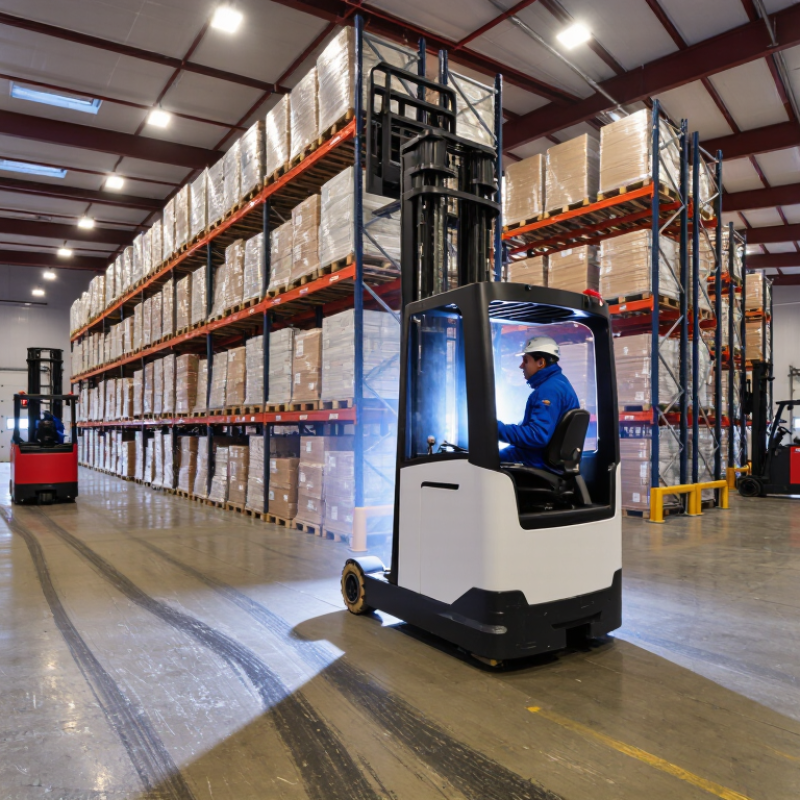
Cold storage changes forklift performance long before a breakdown appears. At -25°C, battery capacity drops, hydraulic oil thickens, and condensation can freeze around sensors. Reach trucks remain valuable in tall freezer aisles because their narrow chassis saves space. However, mast movement may become slower during repeated pallet cycles. Operators should test lift speed, battery endurance, and visibility inside the actual freezer.
Operators should test lift speed, battery endurance, and visibility inside the actual freezer.
Counterbalance trucks suit loading docks and mixed-temperature zones. Their stronger chassis handles uneven floors and heavier pallets, but turning space becomes critical. The Global Cold Chain Alliance reported 719 million cubic meters of global cold-storage capacity in its 2023 report. That scale increases pressure on every aisle. A small steering delay can create serious congestion. It is easy to underestimate this.
AGVs offer consistent routes and reduce exposure to cold environments. MHI’s 2024 Annual Industry Report, based on more than 1,000 supply-chain professionals, shows continuing investment in automation and robotics. Yet AGVs are not automatically better. Frost can affect floor markers, scanners, and charging contacts. Route trials should include wet transitions, plastic wrap, and emergency stops. Perfect automation is an appealing idea. Real warehouses are messier. Battery charging plans also need evidence, not assumptions. Operators should compare measured run time at freezer temperature with the supplier’s laboratory figures. That gap can be uncomfortable, but it matters.
Cold storage changes forklift safety long before the first mechanical failure. OSHA’s Powered Industrial Trucks eTool estimates that forklifts cause about 85 fatal accidents and 34,900 serious injuries each year in the United States. In refrigerated aisles, poor visibility, slippery floors, and reduced turning space increase exposure. OSHA 29 CFR 1910.176(a) requires sufficient aisle clearance for handling equipment and safe access. It does not provide one universal aisle width. Measure the truck, load, rack geometry, and turning path together. A drawing alone is not enough.
Condensation deserves equal attention. Warm, humid air enters when dock doors remain open. Water then forms on floors, sensors, connectors, and overhead lights. Keep doors closed, repair damaged seals, and monitor dew point near transitions. The International Institute of Ammonia Refrigeration highlights moisture control and vapor-barrier integrity as important cold-chain design concerns. Use anti-slip surfaces, visible floor markings, and cold-rated electrical protection. Small puddles can become large operational problems.
Service routines must match the temperature. Cold conditions reduce battery output, stiffen hydraulic fluids, and expose brittle cables. The U.S. Department of Energy identifies refrigeration as a major energy load in refrigerated warehouses, so avoid unnecessary idling and door openings. Inspect brakes, tires, forks, mast chains, and battery condition before each shift. OSHA recommends operator training and regular inspections. In practice, service intervals often need adjustment, not blind adherence. That judgment can be imperfect. Record failures by zone and temperature, then revise the maintenance plan using real uptime data.
Approximate available capacity of lead-acid forklift batteries at different operating temperatures
OSHA 29 CFR 1910.176(a) requires aisles and passageways to remain clear and in good repair. OSHA does not establish one universal aisle width; clearance must support safe vehicle and pedestrian movement.
When equipment moves between cold rooms and warmer humid areas, moisture can condense on electrical and metal surfaces. Use controlled transitions, allow equipment to equalize before charging or servicing, and keep floors dry.
Cold temperatures reduce battery output and can increase charging time. Inspect batteries, connectors, tires, brakes, hydraulics, and defrost-related water accumulation more frequently during winter operation.
Reference basis: approximate lead-acid battery temperature derating commonly used for cold-weather planning, with 20°C treated as the reference point. Actual capacity varies by battery chemistry, age, state of charge, discharge rate, and operating conditions. OSHA references: 29 CFR 1910.176(a) and 29 CFR 1910.178.
Capacity may fall by 20–30% near 0°C. An eight-hour battery may last much less.
Operators may notice slower lifting, weaker acceleration, and earlier low-voltage alarms. Performance can change quickly.
They usually handle cold better than lead-acid batteries. Charging below freezing can still damage cells.
Measure voltage, duty cycles, and recharge time inside the actual warehouse. One test is not enough.
Condensation may form when equipment leaves a cold room. Moisture is easy to miss.
Keep batteries within their specified temperature range. Use insulated charging areas when possible.
Hydraulic oil thickens. Lift cylinders respond slowly, steering feels heavy, and pumps may whine.
No. Lower viscosity may improve flow but weaken the protective oil film. Check the manual, pressure, temperature, and clearances.
Watch the first lift cycle and listen for pump noise. Check stiff seals, hoses, fittings, and possible seepage.
Keep temperature logs and service records. Review them monthly. Some assumptions may be wrong.
How do cold storage environments affect forklift performance? Temperatures of –18°C in freezer rooms and –30°C in deep-freeze zones can reduce battery efficiency, slow charging, and limit available operating time. Near 0°C, battery capacity may decline by approximately 20–30%, making proper battery selection, charging schedules, and spare power planning essential. Cold conditions can also increase resistance in hydraulic systems and cause standard lubricants to thicken, so fluids with suitable low-temperature ISO VG ratings are needed for reliable lifting and steering.
The leading forklift options for 2026 cold-storage operations include reach trucks for narrow aisles, counterbalance trucks for flexible material handling, and automated guided vehicles for repeatable transport tasks. Safety and uptime depend on maintaining compliant aisle widths, controlling condensation during temperature transitions, inspecting equipment regularly, and scheduling preventive service. Operators should also monitor visibility, traction, controls, and hydraulic response to reduce delays, protect loads, and maintain consistent performance in demanding refrigerated environments.

AJ Forklifts