What is the maximum lifting height for a standard stacker? The practical answer is usually between 1.6 and 3.5 metres, depending on the mast, rated load, and machine design. Some high-lift pedestrian stackers reach approximately 5 metres, but they should not be treated as ordinary warehouse models. The phrase “standard stacker” is not a precise engineering classification. That matters.
The MHI 2024 Annual Industry Report identifies labor pressure, space utilization, and warehouse productivity as continuing material-handling priorities. These pressures often encourage taller storage. However, height alone does not determine suitability. OSHA 29 CFR 1910.178 and ANSI/ITSDF B56.1 emphasize trained operators, rated capacity, stability, and safe operating conditions. A 1,000-kilogram stacker may lift far less at maximum height. The load may also project forward, especially with uneven pallets. Small details become serious.
Mike O’Donnell, a material-handling safety specialist, stated, “Lift height is useful only when the truck remains stable, controlled, and within its rated capacity.” That principle should guide every specification review. Buyers should compare lowered mast height, maximum lift height, residual capacity, aisle width, and floor condition. Product brochures sometimes highlight the tallest figure. They rarely show the full operating picture. Frankly, that can mislead inexperienced buyers.
This guide examines realistic lifting ranges for 2026 standard stackers. It also considers warehouse clearance, pallet dimensions, battery weight, and operator visibility. The maximum number is only one part of the decision.
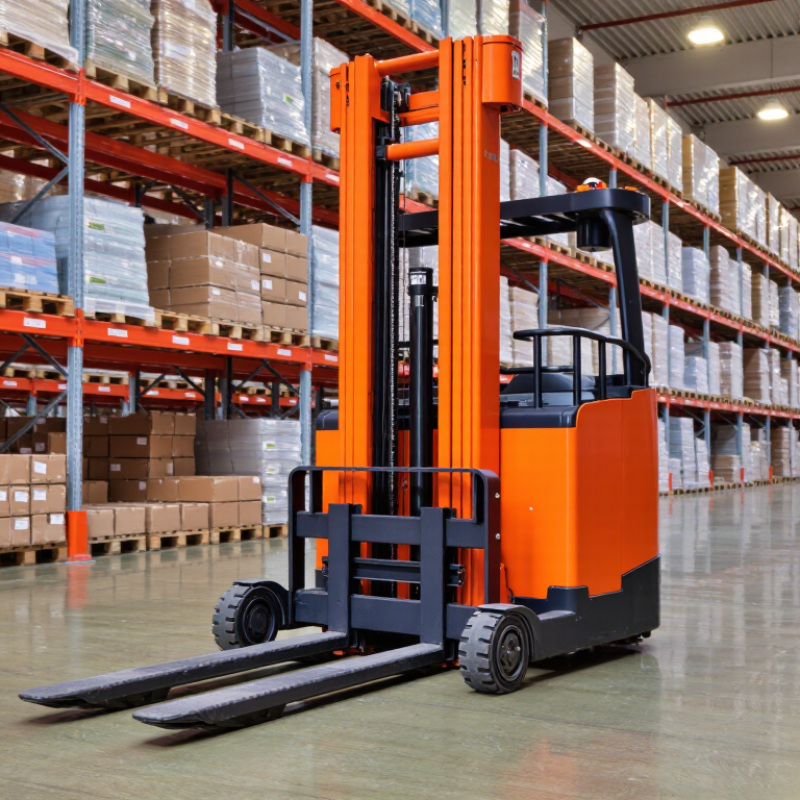
A standard stacker is a compact lifting tool for pallets, cartons, and short-distance warehouse movement. It normally combines a mast, forks, steering handle, and electric or manual drive. Most pedestrian standard stackers lift between 1.6 and 3.5 meters. Some specialized versions approach 5 meters, but that should not define the “standard” category. The real limit depends on mast design, rated capacity, pallet dimensions, battery weight, and floor condition. A 1,000-kilogram rating at floor level may fall sharply at maximum height. A neat number can mislead.
Its role in material handling is practical. It places pallets on low and medium storage racks, supports replenishment, and reduces repeated manual lifting. MHI’s 2024 Annual Industry Report identifies labor availability and operational efficiency as major drivers of automation investment. A stacker fits this transition without requiring a fully automated warehouse.
It can work in narrow aisles, though turning space still matters. I have seen layouts fail because teams measured rack height but ignored mast clearance and overhead lighting.
Safety remains part of performance. OSHA estimates that powered industrial trucks contribute to about 85 workplace fatalities and 34,900 serious injuries each year in the United States. Operators need trained instruction, stable loads, clear visibility, and routine inspections. The International Organization for Standardization’s ISO 3691-1 also addresses safety requirements for industrial trucks. These figures do not prove every stacker is dangerous. They show why lifting height must be evaluated with load stability, traffic flow, and operator experience. More height is not always better.
A standard stacker’s maximum lifting height depends on more than its advertised mast rating. Mast design, lifting stages, and the required collapsed height all affect the final figure. A warehouse with low doorways may need a two-stage mast, while taller racking often requires a three-stage design. Numbers can mislead.
Rated capacity also changes as the forks rise. A stacker may lift 1,500 kilograms near floor level but handle less at its highest position. The load center matters too. A long or uneven pallet places greater leverage on the mast. Operators should check the capacity chart at the exact lifting height, not rely on the headline specification.
Battery condition, hydraulic performance, floor quality, and wheel alignment can influence real lifting results. A weak battery may slow lifting or reduce working cycles, especially during repeated pallet movements. Uneven concrete can make a tall load sway. Measure twice. The aisle width and overhead clearance must also be checked with the mast fully extended.
In warehouse assessments, I compare the requested rack height with the stacker’s usable height and residual capacity. For example, a 3,000-millimeter rating may not suit a 2,800-millimeter shelf if the pallet is tall and clearance is limited. Earlier estimates often ignored pallet height, leaving too little space above the load. That is an easy mistake. A practical selection should include load dimensions, daily lifting frequency, floor conditions, and the operator’s sightline. Clear visibility can matter as much as another 100 millimeters of reach.
In 2026, standard stackers usually lift loads between 1.6 and 3.5 meters. Walkie models often reach 1.6–2.5 meters. Straddle and counterbalanced versions commonly reach 2.5–3.5 meters. Some reinforced units approach 4.5 meters, but they should not be treated as ordinary standard stackers.
The maximum lifting height depends on mast design, rated capacity, load center, and battery weight. A 1,000-kilogram stacker may lift less than its 600-kilogram configuration. The difference can be substantial. Manufacturers typically reduce capacity as the mast rises, especially above three meters. Floor flatness and pallet condition also affect safe operation, although product brochures rarely emphasize these details.
The 2024 MHI Annual Industry Report identified labor availability and warehouse space utilization as major material-handling priorities. This helps explain the demand for taller, narrower storage equipment. However, extra height does not automatically improve productivity. OSHA guidance states that loads must remain stable and within the truck’s rated capacity during lifting and travel. In practical warehouse trials, operators should measure the highest rack beam, pallet clearance, and aisle turning space before selecting a 2026 model. A 3.0-meter lift may be adequate in one facility, yet insufficient in another. Published figures are useful, but real sites remain messier.
Maximum lifting height means the highest position reached by the fork surface. It does not always mean the top of the load or backrest. Check the equipment specification plate and operating manual before measuring. Rated capacity can change at greater heights.
Park the stacker on a firm, level floor. Lower the forks fully, then place a tape measure beside the mast. Measure vertically from the floor to the upper fork surface. Raise the forks slowly until the lift stops at its rated limit. Keep the mast upright. Record the measurement in millimeters.
Use a laser level when possible. It reduces reading errors near tall masts. Repeat the test three times. Small differences may indicate floor movement, mast flex, or hydraulic drift. I have found that a rushed measurement often includes the fork backrest by mistake. That result looks impressive but may be inaccurate.
Verification should include a suitable test load, within the stated capacity. Lift it to the declared height without tilting or sudden movement. Watch for unusual noise, uneven fork travel, or visible oil leakage. Measure again after lowering the load. If the loaded height differs significantly, stop using the result and request a qualified inspection. Record the floor condition, load weight, measurement point, and test date. These details make the figure easier to review later.
2026 Best Standard Stacker: What Is the Maximum Lifting Height?
Choosing the right stacker height starts with the warehouse, not the catalogue. Standard electric walkie stackers commonly lift between 1.6 and 3.5 metres. Some specialized units reach higher, but maximum height does not equal useful height. Measure the lowest beam, sprinkler clearance, floor slope, and pallet dimensions before selecting equipment. Leave practical clearance above the load.
A 3-metre rack may require a 3.3-metre lifting height. That extra margin helps the operator place pallets without scraping beams. However, higher lifting can reduce residual capacity and increase stability demands. OSHA 1910.178 requires loads to remain stable and within the truck’s rated capacity. Check the capacity chart at the actual lift height, not only the headline rating.
Small details matter.
MHI’s 2024 Annual Industry Report found that 55% of supply-chain leaders planned to increase technology investment. Yet more technology cannot correct poor height planning. In daily use, observe turning space, aisle congestion, battery charging points, and operator visibility. A 2.5-metre stacker may work better than a 4-metre model in a busy warehouse. This is where judgment becomes less tidy. I would also recheck the decision after seasonal inventory changes, because the “right” height can quietly become wrong.
Choosing the right stacker height depends on rack levels, ceiling clearance, pallet size, and required operating aisle space. Standard pedestrian stackers commonly provide lifting heights from approximately 1.6 m to 3.5 m, while specialized high-lift models can reach about 4.5 m.
The figures show representative maximum lifting heights for common warehouse tasks. Always verify the rated capacity at the required lift height, mast configuration, floor conditions, and local safety requirements before selecting equipment.
A standard stacker is a compact lifting tool for pallets, cartons, and short warehouse movements. It usually has forks, a mast, steering controls, and manual or electric drive.
Most pedestrian models lift between 1.6 and 3.5 meters. Walkie models often reach 1.6 to 2.5 meters.
No. Rated capacity usually decreases as the forks rise. A 1,000-kilogram rating at floor level may be lower near the top.
Load weight, pallet length, and load-center distance all matter. A long or uneven pallet creates more leverage against the mast.
Measure rack height, pallet height, aisle width, doorway clearance, and overhead lighting. Check the mast fully extended.
Not always. Greater height can support narrow storage, but poor visibility or tight turning space may reduce output. More height is not always better.
Yes. A weak battery may slow lifting during repeated movements. Uneven concrete can make a raised load sway.
Operators need proper training, stable loads, clear sightlines, and routine inspections. They should confirm the capacity chart at the exact lifting height.
Not automatically. A tall pallet may leave too little clearance above the shelf. Earlier estimates often miss this detail.
Relying only on the headline mast number. Real warehouses are messier, and a neat specification can still mislead.
Standard stackers are essential material-handling machines for lifting, positioning, and storing palletized goods in warehouses, workshops, and distribution areas. Their maximum lifting height depends on several factors, including mast design, rated load capacity, fork length, machine stability, power system, and operating conditions. So, what is the maximum lifting height for a standard stacker? In 2026, common models typically offer lifting heights from approximately 1.6 to 3.5 meters, while specialized configurations may reach higher levels when used with suitable loads and controlled warehouse layouts.
To measure and verify the maximum lifting height, operators should check the equipment specification plate, raise the forks under no-load or rated-load conditions, and measure from the floor to the highest usable fork position. The correct height should match the warehouse’s rack dimensions, aisle space, ceiling clearance, and daily load requirements. Selecting a stacker with excessive height may increase cost and reduce stability, while insufficient height can limit storage efficiency. A balanced choice supports safe, reliable, and productive warehouse operations.

AJ Forklifts